It might surprise you to know that Crocus sativus L., better known as saffron, has a fascinating genesis tale in which the ancient gods played a significant role in the development of such a beautiful and mystical plant. According to legend, God Hermes accidentally killed Crocus, one of his closest friends, while competing in a disc-throwing contest. Hermes, who was grieving, changed Crocus‘ body into a flower after he died, and the drops of blood that fell from his head were changed into the red stigmas seen in the center of the saffron flower. One might be wondering whether or not the genus names of other plants also have cultural roots.
All facets of informal culture, whether tangible or immaterial, are referred to as popular culture. Saffron has played a significant part in the popular culture of the regions where it has been extensively grown for a long time. Here, we at Ravang invite you to join us on an exciting journey about the history of saffron uses in the civilizations of Iran, Spain and India. These countries are well-known for the highest amount of saffron production across the world.
Iran
The colorful and aromatic saffron has a unique place in Iranian culture. In addition to being widely utilized in culinary dishes, it also has a big part in religious rituals, prayers, and talismans. Saffron has been used since antiquity when it was greatly valued and thought to have mystical characteristics. Saffron was connected to many gods and other supernatural entities and was seen as a sign of divinity.
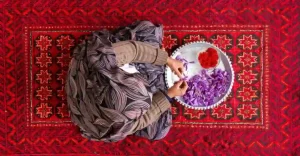
A woman is cleaning saffron flowers on an old and hand-woven carpet in Torbat-e Heydarieh.
Iranians commonly utilized saffron in their prayers and ceremonies to invoke the blessings of love, fertility, and wealth as well as celestial protection. It was often sprinkled or offered on sacred objects, altars, and prayer mats.
Additionally, saffron was used in talismans that were meant to ward off evil spirits, offer luck, and provide protection. These talismans were carried in pockets or worn as jewelry and there was a huge belief that saffron addition to such talismans enhance their power and effectiveness.
Furthermore, saffron is renowned for its healing qualities and is thought to provide psychological and spiritual benefits. Saffron unique perfume is thought to help with meditation and focus by soothing the mind. Moreover, it is thought to purify the soul, uplift the spirit, and promote inner tranquility.
Spain
Azafrán, the Spanish word for saffron, has a major cultural and religious significance in Spain. Saffron has been used in prayers and talismans since ancient times when it was admired as a sacred herb.
During the Holy Week processions, saffron-colored robes are worn by religious participants as a representation of holiness, sacrifice, and purity. Saffron’s vivid hue symbolizes dedication and faith, and it is believed to bring blessings to both the wearer and the surrounding area.
Spanish people regularly use saffron to create talismans that promise luck and protection. These talismans are typically adorned with saffron threads, believers wear or carry them to ward off evil spirits and to uphold their spiritual well-being.
Saffron is also utilized as a natural cure for a variety of illnesses in traditional medicine. This medicine herb may be used in religious rituals to promote body healing or mental happiness.
India
केसर, Hindi name of saffron, is utilized frequently in prayers and talismans in India because of its profound cultural and religious significance.
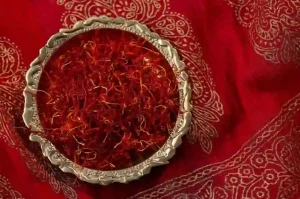
Hindu ceremonies and rituals frequently include giving saffron to gods and goddesses as a sacred spice representing holiness, luminosity, and prosperity. Saffron is used to adorn deities during worship and is offered alongside other items like flowers and incense.
Saffron is offered to Buddhas and Bodhisattvas as a sign of knowledge in Buddhist traditions. Buddhist monks also dress in saffron-colored robes as a sign of renunciation and devotion to their spirituality.
It is important to note that the specific use of saffron in prayers and talismans may vary across different regions and communities in India. The significance and rituals associated with saffron can also differ based on individual beliefs and practices.
Indian might use saffron to create talismans. They combine it with other sacred materials like gemstones, herbs, or holy ashes and believe such a mixture has the power of protective and healing properties.
Ayurveda, a traditional Indian medical system, has employed saffron for centuries. This system believes that saffron has various health benefits, such as improving digestion, enhancing mood, and treating respiratory ailments. In Ayurvedic practices, saffron may be used in prayers, rituals, and medicine preparations.
There are many other examples of traditional and medical use of saffron in various cultures. In the end, we should note that the impact of saffron on popular culture extends beyond its involvement in the planting, growing, and harvesting processes; it also encompasses diverse areas such as food, prayer, popular medicine, literature, and more. Research on culture-related items of saffron is considered an important and hottest topic that every saffron export company should be familiar with to reach the best performances in trading.