The process of saffron cultivation involves careful planning and preparation of the land to ensure optimal growth and yield. The very first step in saffron cultivation is to select a suitable site with well-drained soil and adequate sunlight. Once the site is selected, the land is prepared by plowing, harrowing, and leveling the soil to create a smooth, even surface. The saffron bulbs are then planted in shallow trenches, and the soil is carefully watered to promote germination. With proper care and attention, saffron cultivation can yield a bountiful #harvest of this valuable spice. We’d like to share some helpful advice on what to do before and during saffron cultivation so that the output of the crop will increase. Here they are:
#Cultivation
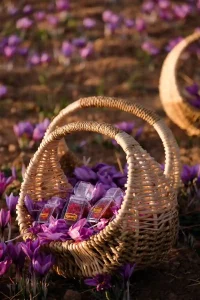
The environment of the Mediterranean region, with its hot, dry summer breezes blowing through arid and semi-arid lands, is most conducive to the saffron crop’s success. However, the plant can endure harsh winters, enduring brief periods of snow cover and frosts as cold as -10°C. Saffron plants thrive in direct sunshine and do not do well in shaded environments. As a result, planting works best in fields that slope south in the Northern Hemisphere. When corm crowding starts to reduce saffron yield and cultivation becomes unprofitable, the old crop is replaced. In Italy, saffron is grown as an annual crop and in France, it is uprooted after 3 years. In Spain, corms are uprooted after every fourth year.
#Land_Preparation
Well-care land preparations are necessary to create a friable and loose texture for saffron cultivation. The field is plowed 4–5 times to a depth of 30–35 cm to bring the soil into fine tilth. The field should be cleared off of all the weed growth, penetrating roots, and stubble stones.
#Planting_Time
The planting period of saffron varies from region to region depending upon climatic conditions. Some academic sources have reported that the best time for planting corms is mid-May and especially early June, in Iran; the second fortnight in August in Italy; 15–30 June in Spain; before the middle of September in Greece; and from the middle of July to August in India.

#Spacing and #Crop_Density
The ideal spacing/crop density for saffron cultivation depends on various factors such as the climate, soil type, irrigation, and the variety of saffron being grown. However, in general, saffron bulbs should be planted at a depth of 10-15 cm and spaced 10-15 cm apart in rows that are 20-30 cm apart. This translates to a density of about 150-200 bulbs per square meter.
These are some important factors in #saffron #farming that help #enhancedproductivity. This interesting topic will be continued on the Sabbaghzadeh Trading Company soon. Don’t miss that upcoming content, and importantly share your valuable perspective with us.